 US Dollar
 Australian Dollar
 Euro
Euro
 CAD
CAD

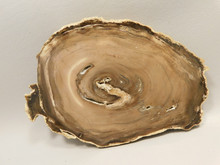
Another type of “damage” seen in Petrified Wood is from insects.
Though origin and evolutionary history of this is poorly understood to date, as the fossil record is scarce, evidence for herbivory insects appears in the Carboniferous. The oldest examples of marginal and surface feeding are on Carboniferous seed fern leaves and that is attributed to mites.
The first beetle borings are believed to be from the Triassic. There are some borings in permineralized Triassic-aged wood from Arizona that are attributed to termites or bees; however, they may be beetle borings. To date, the earliest definitive beetle wood borings were documented in middle Permian conifer wood from Tikhie Gory, Russia. Termite borings appear in the Cretaceous. Leaf mines are meandering tunnels produced by the feeding larvae of some beetle, fly, and sawfly species. The first definitive leaf mines first appear in the leaves of Triassic conifers. Interestingly, the abundance and diversity of fossil leaf mines coincide with the introduction of flowering plants (Angiosperms) during the Cretaceous.
Trace fossils record the activities of organisms. Tracks, burrows, eggshells, nests, tooth marks, gastroliths (gizzard stones), and coprolites (fossil feces) are examples of trace fossils or ichnofossils. Trace fossils in petrified wood represent activities that occurred while the tree was alive. Insect ichnofossils can be helpful in determining what types of insects were present at a particular time and provide information about the nature and persistence of past plant-insect associations.
So, what you may see in petrified wood is spots or tunnels caused by wood boring insects that burrowed through the tree when it was alive, millions of years ago. The larvae of wood-boring beetles hatch and excavate tunnels in wood during their development. As the trees were still alive at the time of the wood boring insect or beetle attack, they sometimes responded by subsequent filling of the borings as a wound reaction. When the tree is fossilized those areas may be replaced with different minerals and show up as different colored spots or tunnels.
Sometimes both fungi (discussed last month) and wood boring insects are found together as the fungus helped decay the wood so the insects could digest it. Other wood boring insects are termites and ants. The tunnels of their nest are often visible running through the petrified wood, as well as fossilized deposits of eggs, fecal matter, or even sometimes dead insects.
Other fossil can also appear in Petrified Wood. The Eden Valley Blue Forest petrified wood has been found with worm holes, insect borings, woodpecker holes, rare lichen fossils and small clam shells. When the trees fell into the shallow lakes, some 50 million years ago, they often became covered in algae. The algae provided a wonderful habitat for tiny seed shrimp that then died and were fossilized within the wood/algae. These fossils are called fossilized ostracod exoskeletons.
Happy hunting!