 US Dollar
 Australian Dollar
 Euro
Euro
 CAD
CAD

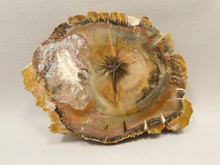
Once again, I would like to explain that, though we have been in the rock and mineral business for 40 plus years, Petrified Wood is not our specialty. However, recently we bought a HUGE collection and I have made it my business to learn all I can for my customers-so I am doing a series of blogs sharing all that I am learning. I am not a fossil wood scholar, these are not scientific papers and I welcome any advice or information from better experts than me!
This month we will discuss fungus in Petrified Wood.
Records of fungus or fungi extends back as early as that of the first record of plants and animals!
Wood decay is caused by numerous organisms, of which fungi, white rot and white pocket rot in particular, are the most important considering their relative abundance and enzymatic activity. Even though records are poor, we know fungi were everywhere in the ancient past and are still thriving today. Fungi dominated the landscape during the rise of land plants, and they also proliferated in the aftermath of major extinction events.
There is evidence of fungal decay in fossil wood from the Paleozoic, Mesozoic and Cenozoic sediments. Certain Upper Triassic tree trunks in the southwestern U.S.A. show evidence of damage, similar to tree trunks of the present day, by pocket rot fungi such as Polyporus amarus (Polyporites wardii) and Heterobasidion annosum.
In the Araucarioxylon arizonicum, a conifer tree commonly found in the Petrified Forest in the Chinle Formation, in northern Arizona, the fungus Polyporites wardii is found. This fungus was estimated to live between early Permian to late Triassic 295 to 201 million years ago.
These parasitic fungi originally formed on the tree when it was still alive. Sometimes the fungus has also fossilized and appears as a circular or tube-shaped mass in the petrified wood. Sometimes fungus doesn't fossilize quite like wood, instead of silica it may be replaced by another mineral like barite or calcite and often is softer than the petrified wood and therefore the polish doesn't have as nice of a luster as the wood. Sometimes the affected area does not fossilize and/or decomposes too quickly and cavities may be left in fossil wood.
If invasive pathogenic fungi are preserved inside wood, under close examination you may see how they penetrate from cell to cell and also how the tree defended itself by reinforcing the walls of cells that were infected by fungi.
Next month we get to talk about insects in Petrified Wood!
Happy Hunting!