 US Dollar
 Australian Dollar
 Euro
Euro
 CAD
CAD

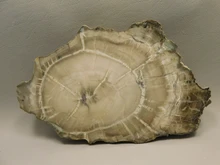
Let me state this right up front-I am not an expert in petrified wood. I have been in the lapidary business for over 40 years, and have, on occasion, sold petrified wood, plus I have some very good friends who are experts in petrified wood. But recently we have purchased a very large collection of petrified wood, which has prompted me to want to learn more about paleobotany, and I am currently trying to learn how to identify the type of tree a piece of petrified wood was. What I am sharing here is my journey, my education, and my opinions!
So, my opinion is that identifying the type of tree that a piece of petrified wood is very difficult!
First off there are believed to be over 60,000 species of trees globally. This does not include undiscovered varieties or extinct varieties (of which most petrified wood probably is). It does however include varieties of the same type-there are over 500 species of oak trees. By comparing similarities to current trees, we can sometimes say that a petrified wood tree is a similar to or like an oak or a like a cypress, but rarely can we drill it down much more than that. Also, understand that the best way to identify a type of tree is by examining it with a loupe or even better, under a microscope. But some features that help identify type of wood may only be seen at a certain angle or with a fresh cut. Two things that are complicated if you have a polished piece already cut a certain way or one you don’t want to damage by recutting. And lastly as permineralization occurred, it does often preserve the original characteristics of the tree, but often those characteristics can be muted, or altered depending on how quickly the wood was replaced, or even absent and replaced completely by opal or agate.
With that said, this month we will begin exploring more about trees and the characteristics that they have that might make it possible for us to identify what type of tree the piece of petrified wood was.
When first looking at a piece of petrified wood we will try to determine if it is an angiosperm or gymnosperm.
Gymnosperms (or softwoods, which includes conifers) all produce seeds that are not enclosed in fruits or nuts, but rather in open structures such as pine cones. They usually have an excurrent form (shaped like a Christmas tree) and are mostly evergreens. Many have tough waxy leaves (pine needles).
Gymnosperms evolved first on earth and actually have a simpler anatomy then the Angiosperms.
Angiosperms (hardwoods) are flowering trees that have their seeds encapsulated in a fruit or a nut.
Most gymnosperms are conifers. The most obvious way to determine conifers from an angiosperm is conifers do not have vessels or pores (some gymnosperms do-such as cycads). Angiosperms generally have both tracheids and vessels. Tracheids are elongated cells with thick walls, while vessels are tube-like structures formed by fused cells. Tracheids have tapered ends and a consistent diameter throughout their length. Vessels are wider and shorter than tracheids and offer a continuous pathway for water transport. Both tracheids and vessels run vertically from theroots to the branches. Most polished petrified wood is cut horizontally for "rounds". If you are looking at a polished round the tracheid will appear as lines filled with a chain of spots. Vessels are much larger and more scattered-these endcuts are called pores.
So, if your piece has the tracheids, but not vessels it is most likely a conifer!
It is fairly easy to identify a gymnosperm from an angiosperm, but there are very few people who can narrow it down accurately to actually what kind of gymnosperm or conifer the petrified wood actually was.
To find out more about trees check out All About Trees.
To find out more about how trees become stone check out What is Petrified Wood?
Next month I will go into a more detailed description of the above-mentioned features, i.e. tracheid, vessels, rays, etc.
Then in the following months we will explore both softwoods and hardwoods a little more!
Thanks for reading and Happy Hunting!