 US Dollar
 Australian Dollar
 Euro
Euro
 CAD
CAD

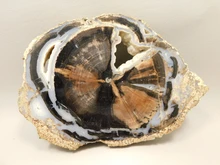
As previously promised, this month I will go more in depth in explaining the tree characteristics used when trying to identifying a piece of petrified wood.
Let’s start with an in-depth look at vessels or pores, since finding them will help you determine if the piece is a conifer or not.
Xylem is the tissue in vascular plants that conducts water (and substances such as minerals dissolved in it) upwards from the roots to the leaves. Two kinds of cells are involved in xylem transport: tracheids and vessel elements.
Tracheids are long and narrow individual cells with thick walls, forming a continuous pathway for water transport.
Vessel elements are shorter, and are connected together end to end into long vertical tubes that are called vessels.
When viewed on a piece of wood cut transversely (horizontally) the opening of the vessel is called a pore. A pore is the largest diameter “circle” you will see in a hardwood round. Some can actually be seen with the naked eye.
As stated last month-The most obvious way to determine if it’s a conifer or angiosperm is conifers do not have vessels or pores (though some gymnosperms do-such as cycads). Although gymnosperms do have a well-developed vascular system, their xylem consists of tracheid rather than vessels.
Other tree characteristics used to help identify types of wood include:
Rays are cells elongated horizontally, that radiate out from the center pith to the outer cambium, crossing the growth rings at right angles. All species oof woods have rays. Rays can vary greatly in size and are very important in wood identification.
Growth Rings, every child knows about growth rings! We all remember counting the rings to see how old a tree is. Growth rings are literally the expansion of a tree during its growing season each year. The size of growth rings varies in different species, but also can vary in the same tree due to conditions during that year. When there is a visible contrast between the first formed and later formed wood in the same ring, the wood is referred to as earlywood and latewood. In some cases, this transition is abrupt and obvious, in others it is a gradual transition. This transition can be an indication of the type of tree.
Gum Ducts/Resin Canals are intercellular tubular canals in certain softwoods, for the secretion or passage of gum or resin.
Parenchyma are cells that live longer and perform metabolic function